Views: 0 Author: Site Editor Publish Time: 2026-01-29 Origin: Site
Choosing the right welding process depends on project requirements and material characteristics. MIG welding offers speed and versatility for many structural materials. TIG welding provides precise control and high-quality finishes. Stick welding excels in portability and tough environments. Laser welding delivers unmatched consistency and efficiency in high-volume production. The most widely used types of welding in industry include MIG and laser, with automation driving demand for advanced welding equipment. The advantages of welding increase significantly when integrating robotics and AI, which enhance precision and repeatability.
MIG welding is fast and versatile, making it ideal for automotive and construction projects.
TIG welding offers exceptional precision and is perfect for detailed work on thin materials.
Stick welding is portable and effective in tough environments, suitable for outdoor and emergency repairs.
Laser welding provides unmatched accuracy and speed, making it the best choice for high-volume production.
Automation enhances all welding processes, improving quality, consistency, and reducing labor costs.
Choosing the right welding method depends on material type, project complexity, and environmental conditions.
MIG welding is beginner-friendly, while TIG requires more skill for high-quality results.
Stick welding is cost-effective, with low initial and operational costs, making it accessible for many users.
The manufacturing industry relies on several types of welding processes to join metal components. Each process offers unique advantages and serves specific applications. The four main types of welding include MIG, TIG, Stick, and Laser welding. These types of welding processes are essential in fields such as automotive, aerospace, construction, electronics, and medical device manufacturing.
MIG welding is widely used in automotive assembly, general metal fabrication, and industrial manufacturing. It joins car frames, body panels, and machinery components. MIG welding also supports maintenance, repair, and DIY projects.
TIG welding is preferred for artistic metalwork, detailed welding, and thin materials. It produces high-quality welds with minimal distortion, making it suitable for aerospace and precision fabrication.
Stick welding excels in construction and heavy-duty fabrication. It works well on dirty or rusty metals and is ideal for outdoor environments.
Laser welding is chosen for high-precision applications in medical equipment, electronics, jewelry, and aerospace. It creates near-invisible joints and protects sensitive components.
These types of welding processes address a wide range of manufacturing needs. The selection depends on material type, required precision, and production volume.
The main types of welding processes differ in technique, outcome, and suitability for various tasks. The following table highlights key distinctions among MIG, TIG, Stick, and Laser welding:
Factor | Laser Welding | MIG Welding | TIG Welding | Stick Welding |
|---|---|---|---|---|
Precision | High, ideal for detail | Good, less than TIG | Exceptional, fine work | Moderate |
Speed | Fast for thin materials | Fast, efficient | Slower, time-consuming | Moderate |
Material Compatibility | Metals, plastics, composites | Steel, aluminum, stainless | Non-ferrous metals, alloys | Steel, iron, alloys |
Cost | High initial, low maintenance | Moderate initial, higher operational | Moderate-high initial, moderate operational | Low initial, low operational |
Ease of Use | Skilled operators needed | Easy for beginners | High skill required | Easy to learn |
Production Volume | High-volume, automated | Large-scale | Less efficient | Small-scale |
Distortion | Minimal thermal | Some spatter, possible | Minimal, clean welds | More distortion |
Applications | Aerospace, medical, electronics | Automotive, construction | Artistic, precision work | Construction, repair |
Advanced technology and automation, such as Welden’s approach, enhance these welding processes. Robotic welding systems decrease costs, improve weld quality, and increase productivity. Collaborative welding cobots work safely alongside humans, allowing quick and consistent programming. Mechanized automation improves precision and adaptability across all types of welding processes.
Tip: Automation and closed workstations, as used by Welden, maximize safety and consistency in high-volume production environments.
The differences among types of welding processes influence project outcomes. Manufacturers select the appropriate process based on material, environment, and production requirements. Welden’s integration of advanced automation ensures reliable, repeatable results for global industries.
MIG welding stands out for its straightforward setup process. Operators only need to prepare the welding machine, select the appropriate wire, and connect the shielding gas. This simplicity reduces preparation time and allows welders to begin work quickly. The continuous wire feed system eliminates the need for frequent electrode changes, which streamlines workflow and minimizes interruptions. MIG welding equipment is designed for intuitive operation, making it accessible for both professionals and those new to welding.
One of the most notable advantages of MIG welding is its accessibility for beginners. The process uses a continuous wire feed and shielding gas, which simplifies the technique and reduces the learning curve. Unlike stick welding, which requires precise control and steady hands, MIG welding allows users to achieve consistent results with less experience. The popularity of MIG welding among hobbyists and entry-level welders demonstrates its appeal to those seeking a reliable method without extensive training.
MIG welding’s user-friendly nature makes it a preferred choice for training programs and workshops, where efficiency and safety are priorities.
MIG welding delivers a high deposition rate due to its continuous wire feed. This feature enables welders to lay down more material in less time compared to TIG welding, which demands slower, more controlled movements. The increased deposition rate directly contributes to higher productivity, especially in environments where large volumes of welding are required.
The process excels in repetitive welding tasks. MIG welding maintains consistent travel speeds and deposition rates, which enhances efficiency during mass production. Manufacturers favor MIG welding for large-scale projects because it reduces cycle times and supports rapid assembly. This advantage is critical when time constraints and output targets drive operational decisions.
MIG welding adapts to a wide range of metals, including steel, aluminum, and stainless steel. Automotive manufacturers rely on MIG welding for assembling vehicle frames and body panels. Construction teams use it to fabricate steel beams and columns. Shipbuilders apply MIG welding to hulls and pipelines, while artists and craftsmen create metal sculptures and custom furniture using the same process.
The versatility of MIG welding extends beyond material compatibility. Welders can use MIG equipment in various settings, from factory floors to outdoor job sites. The process performs well in controlled environments and can be adjusted for different project requirements. This adaptability ensures that MIG welding remains a valuable solution across industries, supporting both routine fabrication and specialized applications.
MIG welding produces cleaner welds than many traditional methods. The process uses a shielding gas that protects the weld pool from atmospheric contamination. This protection reduces the amount of spatter generated during welding. Spatter consists of small droplets of molten metal that can land on the workpiece or surrounding surfaces. Excessive spatter can lead to defects, rough surfaces, and additional finishing work.
When comparing spatter levels across different welding methods, MIG welding offers a significant advantage over stick welding. Stick welding often creates the highest amount of spatter due to its open arc and flux-coated electrodes. In contrast, MIG welding maintains a more controlled arc and uses a continuous wire feed, which helps limit the amount of spatter produced. However, TIG and laser welding generate even less spatter, with laser welding achieving near-zero levels.
The following table summarizes the cleanliness and spatter levels of common welding methods:
Welding Method | Cleanliness Level | Spatter Level |
|---|---|---|
MIG | Higher | Higher |
TIG | Minimal | Minimal |
Stick | Lower | Highest |
Laser | Highest | Near-Zero |
This comparison highlights that MIG welding strikes a balance between efficiency and cleanliness. While TIG and laser welding produce the cleanest results, MIG welding remains a practical choice for many applications due to its speed and adaptability. For most industrial and fabrication projects, the spatter produced by MIG welding is manageable and does not compromise the integrity of the weld.
Note: Using the correct shielding gas and adjusting welding parameters can further reduce spatter in MIG welding, resulting in even cleaner welds.
One of the key benefits of MIG welding is the reduced need for post-weld cleanup. The shielding gas not only limits spatter but also prevents slag formation. Slag is a byproduct that forms when flux-coated electrodes are used, as seen in stick welding. Removing slag requires additional labor and can slow down production.
MIG welding eliminates this step. Welders can focus on producing strong, consistent joints without spending extra time on grinding or chipping away residue. This efficiency translates into faster project completion and lower labor costs. Clean welds also improve the appearance of finished products, which is important in industries where aesthetics matter.
Manufacturers value MIG welding for its ability to deliver clean, uniform welds with minimal finishing required. This advantage supports high-volume production and helps maintain strict quality standards. Welden’s advanced welding systems further enhance these benefits by optimizing parameters and ensuring consistent results across every weld.
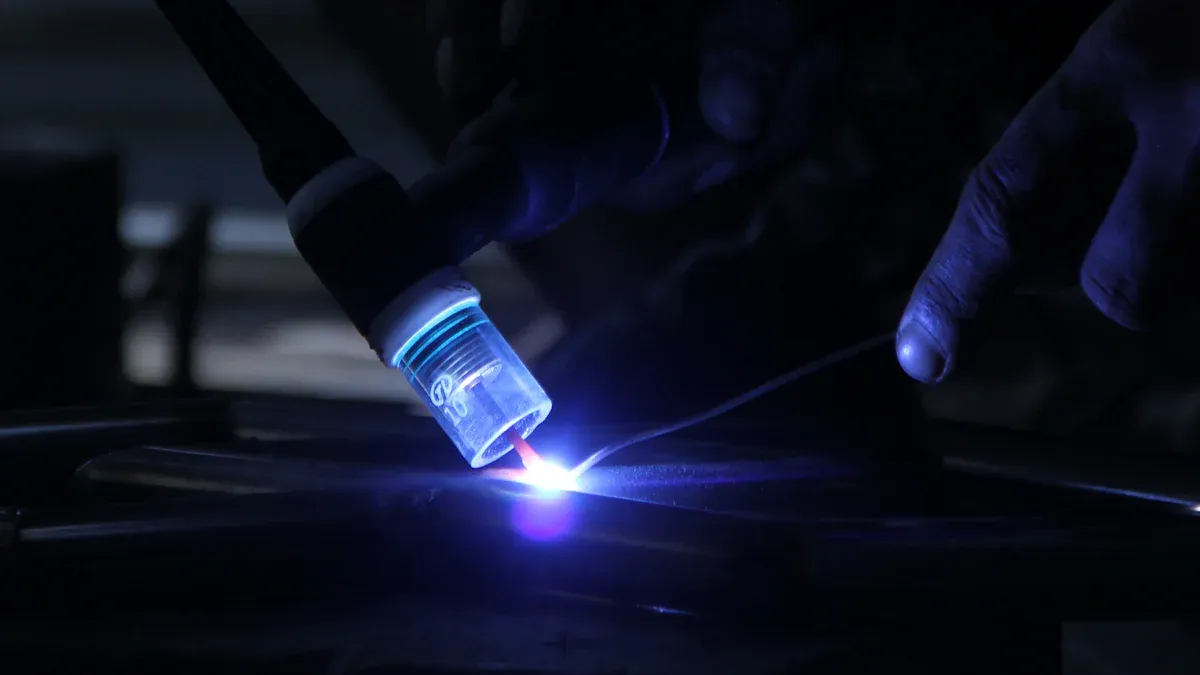
TIG welding stands out for its exceptional precision, making it the preferred choice for intricate and detailed metalwork. The process uses a non-consumable tungsten electrode, which allows the welder to focus the arc with pinpoint accuracy. This capability is essential for applications that demand tight tolerances and flawless finishes, such as aerospace components and custom fabrication. TIG welding minimizes the disadvantages associated with uncontrolled heat input, which often leads to warping or distortion in delicate parts.
TIG welding provides precise temperature control, which minimizes heat distortion effects on the base material.
Studies indicate that TIG welding can reduce the risk of thermal distortion in thin sheet metals by up to 50% compared to other welding methods.
Expert opinions suggest that TIG welding can achieve a reduction in distortion effects by as much as 60% for more susceptible materials.
The ability to adjust heat input during TIG welding offers significant advantages. Welders can fine-tune the amperage to match the thickness and type of material, ensuring optimal penetration without excessive melting. This level of control is especially valuable when working with thin metals or alloys, where overheating can cause burn-through or compromise structural integrity. The process’s flexibility helps mitigate the disadvantages of welding thin materials, which often require careful management of thermal effects.
TIG welding consistently produces clean, visually appealing welds. The process generates minimal spatter and does not require flux, resulting in smooth surfaces and sharp bead profiles. Manufacturers in industries such as medical devices and electronics rely on TIG welding for its ability to deliver aesthetically pleasing joints that meet strict quality standards. The absence of slag and reduced need for post-weld cleanup further enhance productivity.
Weld quality is a hallmark of TIG welding. Skilled operators can achieve joints with high strength, purity, and ductility. TIG welds typically outperform MIG and stick welds in terms of metallurgical bonding and defect rates.
TIG welding produces stronger joints compared to MIG welding when both are performed by skilled welders.
TIG welds typically exhibit higher strength, purity, and ductility due to:
Exceptionally high weld purity, resulting from minimal spatter and effective shielding from contaminants.
Unparalleled control over heat input and filler material, allowing for optimal penetration and fusion.
Superior metallurgical bonding due to slower cooling rates, leading to enhanced ductility and strength.
These attributes reduce the disadvantages of welding processes that are prone to porosity, cracking, or inclusions.
TIG welding excels with thin metals and specialty alloys. The process’s precise heat control and non-consumable electrode enable welders to join materials that would otherwise be vulnerable to distortion or burn-through. TIG welding is often chosen for projects where weld quality and appearance take precedence over speed.
TIG welding utilizes a non-consumable tungsten electrode, allowing for precise and clean welds.
It provides excellent control over heat input, making it ideal for thin materials.
The process is preferred for applications where weld quality and appearance are prioritized over speed.
TIG welding offers the option to weld without filler material, depending on the application. This capability is useful for joining thin sections or performing autogenous welds, where the base metals fuse directly. The flexibility to use or omit filler material adds to TIG welding’s versatility and helps overcome the disadvantages of welding processes that require consumables for every joint.
Tip: TIG welding is ideal for projects demanding high precision, minimal distortion, and superior weld appearance. Its adaptability makes it a top choice for industries where quality cannot be compromised.
Stick welding stands out for its portability. The equipment required is minimal, often limited to a power source and electrode holder. Welders do not need external shielding gas or complex wire feeders. This simplicity allows operators to transport their gear easily between job sites. The compact nature of stick welding equipment makes it ideal for remote locations, temporary structures, and emergency repairs. Welders can set up quickly and begin work without extensive preparation, which reduces the disadvantages associated with bulky or stationary welding systems.
The ability to use stick welding virtually anywhere is a major advantage. Welders can operate in confined spaces, on scaffolding, or in areas without access to electricity by using portable generators. This flexibility supports a wide range of applications, from construction sites to disaster recovery zones. Stick welding’s wind-resistant electrodes enable effective welding in outdoor environments, even when weather conditions are less than ideal. The portability of this process also benefits temporary installations, such as event structures at county fairs, where quick assembly and disassembly are required.
Stick welding excels in heavy-duty projects that demand strong, durable welds. Structural applications, such as building construction and bridge assembly, benefit from the robustness of stick welding. The process creates reliable joints that withstand significant stress and load. Industrial sectors rely on stick welding for outdoor repairs and maintenance, where reliability is critical. The disadvantages of other welding methods, such as sensitivity to contaminants or limited penetration, are minimized with stick welding’s deep fusion capabilities.
One of the most notable strengths of stick welding is its ability to perform on dirty, rusty, or painted metals. The flux coating on the electrode cleans the weld area during operation, allowing welders to achieve solid joints without extensive surface preparation. This feature is especially valuable for on-call repairs in hard-to-reach locations and for maintenance tasks in challenging environments. Stick welding is commonly employed in disaster recovery efforts to repair damaged metal fixtures quickly and efficiently.
Tip: Stick welding’s versatility makes it a preferred choice for outdoor construction sites, emergency repairs, and projects where wind resistance is crucial.
Stick welding is effective in various weather conditions, including wind and rain. The flux coating on the electrode protects the weld area from atmospheric contamination, ensuring consistent results regardless of the environment. Welders can continue working outdoors without the disadvantages posed by humidity or gusty winds, which often disrupt other welding processes.
Unlike some welding methods that are sensitive to wind or moisture, stick welding maintains performance in adverse conditions. The process is a preferred choice for field applications, where reliability and adaptability are essential. Welders can complete projects without delays caused by weather, supporting productivity and project timelines.
Stick welding is effective in various weather conditions, including wind and rain.
The flux coating on the electrode protects the weld area from atmospheric contamination.
This makes stick welding a preferred choice for outdoor and field applications.
The ability to handle challenging environments and surfaces sets stick welding apart from other processes. While some disadvantages exist, such as slower speed compared to automated methods, the benefits of portability, versatility, and all-weather capability make stick welding indispensable for many industries.
Stick welding stands out as one of the most cost-effective welding processes available. The initial investment required for stick welding equipment is significantly lower than that for MIG or TIG welding systems. This affordability makes stick welding accessible to a wide range of users, from small workshops and independent contractors to large construction firms and maintenance teams.
The basic stick welding setup typically includes a power source, electrode holder, ground clamp, and a selection of electrodes. These components are compact and do not require additional accessories such as shielding gas tanks or wire feeders. The simplicity of the equipment reduces both upfront costs and ongoing maintenance expenses. Many operators choose stick welding for its straightforward approach and minimal need for specialized tools.
The following table illustrates the cost ranges for entry-level and advanced welding setups across popular processes:
Welding Process | Cost Range (Entry-Level) | Cost Range (Advanced) |
|---|---|---|
Stick Welding | $200 - $500 | $500 - $3,000 |
MIG Welding | $300 - $800 | $800 - $10,000+ |
TIG Welding | $500 - $1,500 | $1,500 - $12,000 |
As shown above, stick welding offers the lowest entry-level cost among the major welding methods. Even advanced stick welding systems remain more affordable than comparable MIG or TIG setups. This cost advantage allows businesses to allocate resources to other critical areas, such as training, safety equipment, or material procurement.
Operational costs for stick welding also remain low. Electrodes are widely available and inexpensive. The process does not require shielding gas, which eliminates recurring expenses associated with gas refills and storage. Maintenance is straightforward, with fewer moving parts and consumables to replace. These factors contribute to lower total cost of ownership over the lifespan of the equipment.
Tip: For organizations seeking to maximize value without sacrificing reliability, stick welding provides a practical solution. The low setup and operational costs make it ideal for budget-conscious projects, emergency repairs, and environments where portability and flexibility are essential.
Many educational institutions and vocational programs select stick welding for their training courses. The affordable equipment enables schools to offer hands-on instruction to more students, supporting workforce development in manufacturing and construction. Small businesses and startups also benefit from the ability to begin welding operations with minimal financial risk.
Laser welding delivers unmatched accuracy in joining metal components. The process uses a focused laser beam that can be controlled with micron-level precision. This enables manufacturers to achieve flawless weld seams, consistent depths, and optimal heat profiles. Automated laser welding systems use advanced software to adjust parameters quickly, allowing seamless transitions between different parts or materials. Operators can rely on these systems to maintain tight tolerances and produce high-quality finishes, even when working with complex geometries.
Precise beam control sets exact weld seams, speeds, and depths.
Software-based adjustments allow rapid changes without hardware modifications.
Tight tolerances and flawless finishes are achievable, regardless of part complexity.
Laser welding supports precision fabrication in industries where accuracy is critical. The technology ensures that each weld meets strict specifications, reducing the risk of defects and rework.
Laser welding excels in automated production environments. Unlike traditional arc welding, which requires constant human supervision, laser systems operate with minimal manual intervention. Computer controls and vision-guided units manage the welding process in real time, ensuring consistent output and reducing labor costs. The non-contact nature of laser welding further enhances reliability and repeatability.
Automated systems set and monitor weld parameters for each job.
Real-time management ensures consistent quality across large batches.
Non-contact welding reduces wear and maintenance needs.
Manufacturers in high-volume shop fabrication benefit from the scalability and efficiency of laser welding. The process supports rapid production cycles and maintains quality standards, making it ideal for industries such as automotive, electronics, and medical devices.
Laser welding minimizes thermal distortion, which is essential when working with thin or sensitive components. The concentrated heat input limits expansion and contraction, preserving the shape and integrity of the base material. The following table highlights how laser welding compares to other methods in reducing distortion:
Benefit | Description |
|---|---|
Minimal Heat Input | Focuses heat in a small area, limiting thermal effects. |
High Speed | Rapid movement reduces heat spread into surrounding metal. |
Deep, Narrow Welds | Keyhole mode allows deep penetration with less melted metal. |
Precise Control | Micron-level adjustments ensure consistent results. |
No or Little Filler Material | Uses base metals, reducing added mass and thermal impact. |
Less Post-Weld Work | Clean welds require minimal grinding or straightening. |
Ideal for Thin or Complex Parts | Maintains shape and reduces distortion in delicate components. |
Laser welding protects sensitive parts by creating a minimal heat-affected zone. This advantage is crucial in sectors like life sciences and electronics, where even slight distortion can compromise performance.
Laser welding offers significant speed advantages, especially for thin metals. The focused beam melts metal quickly and precisely, allowing for rapid processing times. Manufacturers can increase production capacity without sacrificing quality. The ability to tailor the spot size ensures that thin materials are welded efficiently, reducing the risk of heat-induced issues.
Faster processing times boost production rates.
Spot size adjustment enables precise melting for thin metals.
Reduced heat input prevents warping and burn-through.
Laser welding stands out as a top choice for projects that demand both speed and accuracy. Its efficiency supports high-volume manufacturing while maintaining the integrity of delicate components.
Laser welding stands out for its ability to deliver clean and repeatable welds, especially in automated production environments. Manufacturers rely on this process when they need consistent quality across thousands of parts. The focused laser beam creates a narrow, deep weld with minimal contamination. This precision ensures that each weld meets strict specifications, which is essential for industries such as automotive, electronics, and medical devices.
Automation plays a key role in achieving repeatable results. Welden’s advanced welding systems use robotic arms and closed workstations to control every aspect of the welding process. These systems monitor parameters like beam intensity, travel speed, and focal point. Operators can program the equipment to perform identical welds on each part, reducing the risk of human error. The closed workstation design also protects the weld area from dust and environmental factors, further enhancing consistency.
Several factors contribute to the repeatability of laser welds:
Effective fixturing holds each workpiece in the exact same position for every weld. This eliminates variation and ensures that the laser hits the target area with precision.
Accurate positioning prevents misalignment, which can weaken the weld or cause defects. Robotic systems use sensors and vision technology to verify placement before welding begins.
Stability during welding maintains consistent power density and energy transfer. This leads to uniform weld penetration and appearance, even during high-speed operations.
Manufacturers benefit from these features in several ways. Clean welds reduce the need for post-processing, such as grinding or polishing. Repeatable welds minimize scrap rates and support strict quality control standards. The ability to produce identical joints across large batches is critical for high-volume production, where even minor inconsistencies can lead to costly rework or product failures.
Laser welding also supports traceability and documentation. Automated systems record process data for each weld, allowing manufacturers to track performance and identify trends. This capability is valuable for industries that require detailed records for regulatory compliance or customer audits.
Tip: Consistent laser welds help manufacturers maintain high standards and meet demanding tolerances, especially in sectors where reliability and safety are non-negotiable.
Selecting the best welding process depends on understanding the unique strengths of each method. The following table summarizes the main advantages and typical applications for the four primary types of welding:
Welding Method | Strengths | Applications |
|---|---|---|
MIG | High speed, efficient for thin materials | Automotive, fabrication |
TIG | High precision, clean welds | Aerospace, art projects |
Stick | Versatile, works in various conditions | Construction, repair |
Laser | High precision, minimal heat-affected zone | High-speed production, automation |
Laser welding delivers speed, precision, and minimal heat-affected zones, making it ideal for automated production.
MIG welding is known for high speed and efficiency, especially with thin materials.
TIG welding provides high-quality, clean welds suitable for critical and artistic applications.
Stick welding remains versatile and effective in challenging environments.
Each of the types of welding excels in specific scenarios. Consider the following best uses for each process:
MIG welding suits manufacturing environments that require speed and versatility. It is commonly used in automotive, construction, and aerospace industries. This method is less suitable for thick materials.
TIG welding offers precise control, making it the preferred choice for intricate designs and thin metals such as bike frames and jewelry. It requires more skill and operates at a slower pace.
Stick welding is simple and cost-effective. It performs well on thick materials and in outdoor environments. This process produces more spatter but remains reliable for repairs and construction.
Laser welding is optimal for high-volume production and automation. It excels in applications that demand tight tolerances and minimal thermal distortion, such as electronics and medical devices.
Tip: Matching the welding process to your project’s material, environment, and complexity ensures optimal results and long-term reliability.
Selecting the best welding process involves evaluating several factors. Material type plays a crucial role. For example, aluminum is best welded using TIG, while steel can be joined with stick or MIG. Project size and complexity also influence the choice. Large-scale operations benefit from automated methods like laser welding, while smaller or custom projects may require manual techniques.
Environmental conditions must be considered. Outdoor projects often require welding methods that withstand wind and weather, such as stick welding. Budget and time constraints impact the decision as well. Automated solutions, including those offered by Welden, provide high precision and efficiency, which can reduce overall costs and improve consistency.
Note: Before starting a welding project, assess your needs, research available methods, and consult with industry professionals. Welden’s advanced automation and quality control systems help manufacturers achieve reliable, repeatable results across all types of welding.
By understanding the strengths and best uses of each method, you can select the most effective solution for your application. Welden’s expertise in automated welding and closed workstations ensures safety, consistency, and high-quality outcomes for global industries.
The welding industry supports a wide range of manufacturing sectors, each with unique requirements for joining metal components. Different types of welding play critical roles in shaping products for automotive, electronics, and medical device manufacturing. The selection of a welding process depends on the material, design complexity, and production volume.
The following table summarizes how each welding process is applied across major industries:
Welding Process | Applications in Industries |
|---|---|
Laser Welding | Automotive, Aerospace, Medical Devices, Energy Industry, Heavy Industry, Electronics Industry |
MIG Welding | Automotive Manufacturing, Home Appliance Manufacturing, Robotics and Automation, Metal Furniture Manufacturing |
TIG Welding | Aerospace Industry, Art and Sculpture, Bicycle Manufacturing, Instrumentation |
Stick Welding | Construction, Heavy Equipment Repair, Pipeline Construction, Shipbuilding |
Laser welding is often chosen for intricate welds in automotive, electronics, and medical device production. Its ability to deliver minimal heat input and high precision makes it ideal for sensitive components. MIG welding dominates automotive manufacturing, joining body panels and frames with speed and efficiency. TIG welding finds its place in aerospace and instrumentation, where precision and clean welds are essential. Stick welding remains the preferred method for construction and heavy equipment repair due to its reliability in challenging environments.
The welding industry relies on these processes to meet strict quality and safety standards across diverse applications.
Automation and advanced technology have transformed the welding industry. Modern manufacturing facilities use robotic welding systems and closed workstations to achieve consistent, high-quality results. Automation enables continuous operation, reducing downtime and increasing throughput. Robots perform repetitive tasks with high accuracy, which is crucial for industries requiring tight tolerances.
Key benefits of automation in the welding industry include:
Increased efficiency: Automated systems operate without breaks, accelerating production cycles.
Enhanced productivity: Consistent quality reduces errors and waste, even at high volumes.
Greater precision: Robots follow programmed paths, ensuring accurate welds every time.
Improved safety: Automation minimizes human exposure to hazardous environments.
Welden exemplifies these advancements. The company integrates automated welding robots and closed workstations to ensure maximum safety and repeatability. Advanced quality control systems monitor every weld, reducing defect rates and supporting traceability. These practices set a benchmark in the welding industry, especially for high-volume production in automotive, electronics, and medical device sectors.
Automation not only improves product quality but also lowers operational costs by reducing labor requirements and minimizing material waste.
The welding industry continues to evolve as manufacturers adopt new technologies. Automation, robotics, and data-driven quality control now define best practices, ensuring that every weld meets the highest standards for strength, appearance, and durability.
Selecting the right welding process depends on your project’s needs. The table below highlights each method’s strengths and best uses:
Welding Method | Key Advantages | Typical Applications |
|---|---|---|
Laser | Precision, speed, versatility | Electronics, medical, aerospace |
MIG | Fast, easy, handles thick materials | Automotive, construction |
TIG | High-quality, aesthetic, control | Fragile metals, custom work |
Stick | Simple, effective outdoors | Repairs, harsh environments |
Consider material type, thickness, joint design, production volume, and skill level. Advanced automation, such as Welden’s systems, ensures consistent quality and efficiency. Always match your process to both technical requirements and practical constraints for optimal results.
MIG welding is the most beginner-friendly. The setup is simple, and the process uses a continuous wire feed. Operators can achieve strong welds with minimal training. MIG equipment is widely available and easy to use.
Laser welding provides the highest precision. The focused laser beam allows micron-level control. TIG welding also delivers excellent accuracy for detailed work, especially on thin metals and specialty alloys.
Automation improves welding quality by ensuring consistent parameters and repeatable results. Robotic systems reduce human error and maintain tight tolerances. Welden’s automated workstations enhance safety and reliability in high-volume production.
MIG welding works with steel, aluminum, and stainless steel. The process adapts to various thicknesses and shapes. Manufacturers use MIG welding for automotive frames, construction beams, and metal furniture.
Stick welding is ideal for outdoor projects. The flux-coated electrode protects the weld from wind and moisture. Operators can use stick welding in remote locations and harsh environments without external shielding gas.
Welden uses automated welding robots and closed workstations. Advanced software monitors each weld for accuracy. Quality control systems track performance and maintain strict standards across all production batches.
Laser welding benefits automotive, electronics, and medical device industries. The process delivers clean, precise welds with minimal distortion. Manufacturers rely on laser welding for high-speed, automated production and sensitive components.