Views: 0 Author: Site Editor Publish Time: 2026-01-29 Origin: Site
Type II anodizing works best for decorative or light-duty aluminum parts, while Type III anodizing is ideal for heavy-duty, high-wear environments. The table below highlights the main differences:
Feature | Type II | Type III |
|---|---|---|
Durability | Moderate | Maximum |
Thickness | 5–25 μm | 25–100 μm |
Appearance | Wide color options | Limited color choices |
Cost (per part) | $8 | $15 |
Typical Uses | Consumer, cosmetic | Industrial, high-wear |
Selecting the right anodizing depends on application requirements, expected service life, budget, and appearance. Welden provides both options, guiding you through How to Know if Type II Anodizing Is Right for My Aluminum Parts?.
Type II anodizing is best for decorative and light-duty applications, offering a wide range of color options.
Type III anodizing provides maximum durability and wear resistance, making it ideal for heavy-duty and industrial environments.
Consider the operating environment when choosing anodizing; Type II suits mild conditions, while Type III is for harsh settings.
Type II anodizing is more cost-effective, while Type III has a higher upfront cost but offers longer-lasting protection.
Evaluate the aesthetic needs of your project; Type II allows for vibrant colors, whereas Type III has limited color choices.
Always account for thickness changes due to anodizing; Type II adds 5-25 µm, while Type III adds 25-100 µm.
Consult with experts like Welden to ensure the right anodizing process aligns with your project requirements and standards.
Understanding the specific needs of your application will help you select the most suitable anodizing type for optimal performance.
Anodizing is an electrochemical process that transforms the surface of aluminum into a durable, corrosion-resistant oxide layer. This process takes place in a controlled environment, usually involving a sulfuric acid bath. When an electric current passes through the aluminum part, the surface reacts with oxygen to form aluminum oxide. This oxide layer becomes an integral part of the metal, not just a coating on top.
The anodizing process involves several key steps:
Cleaning the aluminum to remove contaminants.
Immersing the part in an acid electrolyte bath.
Applying an electrical current to trigger oxidation.
Sealing the surface to lock in the protective properties.
The chemical reactions during anodizing can be summarized as follows:
2Al + 3H2O → Al2O3 + 6H+ + 6e−
4Al + 6(H2SO4) → 2Al2O3 + 6(SO−3) + 3(H2)g + 6H+ + 6e−
This process enhances the surface by increasing hardness, improving corrosion resistance, and providing electrical insulation.
Manufacturers choose anodizing for aluminum parts to achieve a range of functional and aesthetic benefits. The process not only protects the metal but also improves its appearance and performance in demanding environments.
Benefit | Description |
|---|---|
Corrosion resistance | The oxide layer acts like a shield, helping parts survive in tough conditions like offshore, aerospace, and industrial settings. |
Durability | The surface is scratch-resistant and tough, ideal for parts that see regular use or handling. |
Electrical insulation | The anodized layer is non-conductive, preventing short circuits and improving safety near wiring or electronics. |
Clean look | Clear or black finishes provide a professional and polished appearance, suitable for customer-facing parts. |
Low maintenance | Anodized parts are easier to clean and less likely to wear down or flake over time. |
Strong dye retention | When dyed, the finish resists fading better than paint or powder coatings. |
Better adhesion | Anodized surfaces improve adhesion for paint or glue, useful for downstream assembly. |
Repeatability | The process delivers consistent results across batches. |
Anodizing offers a reliable way to extend the lifespan of aluminum components while maintaining a consistent and attractive finish.
Welden stands out as a trusted provider of advanced anodizing and finishing services. The company uses state-of-the-art technology and skilled craftsmanship to deliver high-quality results for a wide range of industries. Welden’s surface treatments include anodizing, coating, plating, and polishing. These processes help protect aluminum parts from corrosion and wear, while also enhancing their appearance.
Welden’s expertise covers every stage of production, from initial fabrication to final finishing. The team ensures that each part meets strict quality standards and customer requirements. Welden’s anodizing services support both decorative and functional needs, making them suitable for consumer products, industrial equipment, and specialized applications.
Welden’s commitment to innovation and quality control ensures that every anodized aluminum part performs reliably in its intended environment.
Type II anodizing is a widely used method for enhancing aluminum surfaces. The process begins with thorough cleaning of the aluminum part to remove any contaminants. The part is then immersed in a sulfuric acid electrolyte bath. An electric current passes through the bath, causing the surface of the aluminum to oxidize and form a controlled, uniform oxide layer. This layer becomes an integral part of the metal, providing a versatile and durable finish.
Industry standards specify that type ii anodizing typically produces a coating thickness ranging from 0.0001” to 0.001”. This thinner layer offers flexibility for a variety of applications, especially where tight tolerances are important. The table below compares the thickness and durability of type ii anodizing with type iii:
Anodizing Type | Typical Thickness | Durability |
|---|---|---|
Type II | 0.0001”–0.001” | Thinner, versatile |
Type III | 0.0005”–0.003” | Thicker, suitable for extreme conditions |
Welden’s advanced anodizing lines ensure precise control over the process, resulting in consistent quality and reliable corrosion protection on aluminum parts.
Type ii anodizing benefits a wide range of industries by delivering a balance of performance, appearance, and cost-effectiveness. The process provides moderate corrosion resistance, making it suitable for environments where exposure to moisture or chemicals is a concern. The oxide layer also improves scratch resistance and helps maintain the part’s appearance over time.
One of the standout features of type ii anodizing is its broad selection of color options. The porous nature of the oxide layer allows for deep dye penetration, resulting in vibrant and long-lasting finishes. The table below highlights common color choices and their impact on aesthetics and applications:
Color | Aesthetic Impact | Applications |
|---|---|---|
Clear/Silver | Maintains natural aluminum appearance, enhances durability and corrosion resistance | Architectural, electronics, automotive components |
Black | Offers a sophisticated look, excellent UV resistance and corrosion protection | Architectural elements, consumer electronics |
Blue | Ranges from pastel to vibrant, versatile in design | Aerospace, medical industry, consumer electronics |
Red | Bold and eye-catching, ideal for impactful visuals | Automotive parts, medical devices, fashion accessories |
Green | Natural and refreshing, evokes sustainability | Architectural elements, eco-friendly products |
Gold | Luxurious finish, popular for decorative items | Jewelry, decorative hardware, high-end products |
Custom Colors | Allows for unique designs and branding opportunities | Various applications, tailored to corporate needs |
Welden’s expertise in decorative and functional anodizing ensures that every part receives a finish tailored to its intended use, whether for visual appeal or enhanced durability.
Type ii anodizing is the preferred choice for many consumer and commercial products. Its versatility makes it ideal for applications where appearance, moderate corrosion protection, and cost are key considerations. Common uses include:
Consumer electronics housings and bezels
Automotive trim and interior components
Architectural hardware and fixtures
Medical device casings
Sporting goods and outdoor equipment
Manufacturers select type ii anodizing when they need reliable corrosion resistance, a wide range of color options, and a cost-effective solution for aluminum parts. Welden’s comprehensive finishing services support both high-volume production and custom projects, ensuring each component meets strict quality and performance standards.
Type iii anodizing, also known as hard coat anodizing, produces a much thicker and denser oxide layer on aluminum surfaces compared to standard anodizing. The process begins with a thorough cleaning of the aluminum part. The part is then submerged in a chilled sulfuric acid bath. Operators apply a higher current and maintain a lower temperature than in type ii anodizing. This combination creates a hard, wear-resistant layer that integrates with the base metal.
The resulting layer typically measures between 25 and 150 micrometers (µm) in thickness. This increased thickness is critical for applications that demand maximum durability. The hard coat layer achieves hardness values in the HV 400–500+ range, which significantly boosts the surface’s ability to withstand abrasion and mechanical stress. The dense structure of the layer also provides excellent electrical insulation and corrosion resistance.
Type iii anodizing benefits industries that require components to perform reliably under extreme conditions. The process delivers superior abrasion resistance, making it ideal for parts exposed to frequent movement or contact with other surfaces. The thick oxide layer reduces friction-related wear and extends the service life of aluminum parts.
Key benefits of type iii anodizing include:
Exceptional wear resistance due to the hard coat layer’s high hardness.
Enhanced corrosion protection, even in aggressive environments.
Improved thermal stability, allowing parts to operate at elevated temperatures.
Consistent performance across large production runs.
Welden’s advanced finishing capabilities ensure that every type iii anodizing project meets strict quality standards. The company’s expertise in hard coat anodizing allows for precise control over layer thickness and uniformity, resulting in high-performance finishes for demanding applications.
Type iii anodizing is the preferred choice for aluminum parts used in harsh or high-wear environments. Industries rely on this process to protect critical components and maintain performance over time. Common applications include:
Aerospace: Aircraft landing gear and engine parts require the durability and corrosion resistance provided by type iii anodizing.
Marine: Hardware exposed to saltwater benefits from the thick, protective layer.
Chemical processing: Housings and brackets that face industrial chemicals use type iii anodizing for long-term protection.
High-temperature operations: Components that function above 200°F depend on the thermal stability of the hard coat layer.
The versatility of type iii anodizing extends to military, automotive, and heavy equipment sectors. Welden delivers high-performance finishes that meet the needs of these industries, ensuring each part receives the optimal layer thickness and hardness for its intended use.
For projects that demand maximum durability, superior abrasion resistance, and long-lasting protection, type iii anodizing stands out as the industry standard.
Durability and wear resistance are critical factors when selecting an anodizing process for aluminum parts. Type ii anodizing provides a moderate level of protection, making it suitable for components that face light to moderate wear. The protective layer formed during this process offers reliable corrosion resistance and helps maintain the appearance of parts over time. However, in environments where abrasion or repeated contact is common, type iii anodizing stands out.
Type iii anodizing, often called hardcoat anodizing, creates a much thicker and denser protective layer. This results in exceptional wear resistance, allowing parts to withstand harsh mechanical stress and frequent use. The hardcoat layer not only resists scratching but also extends the lifespan of aluminum components in demanding applications.
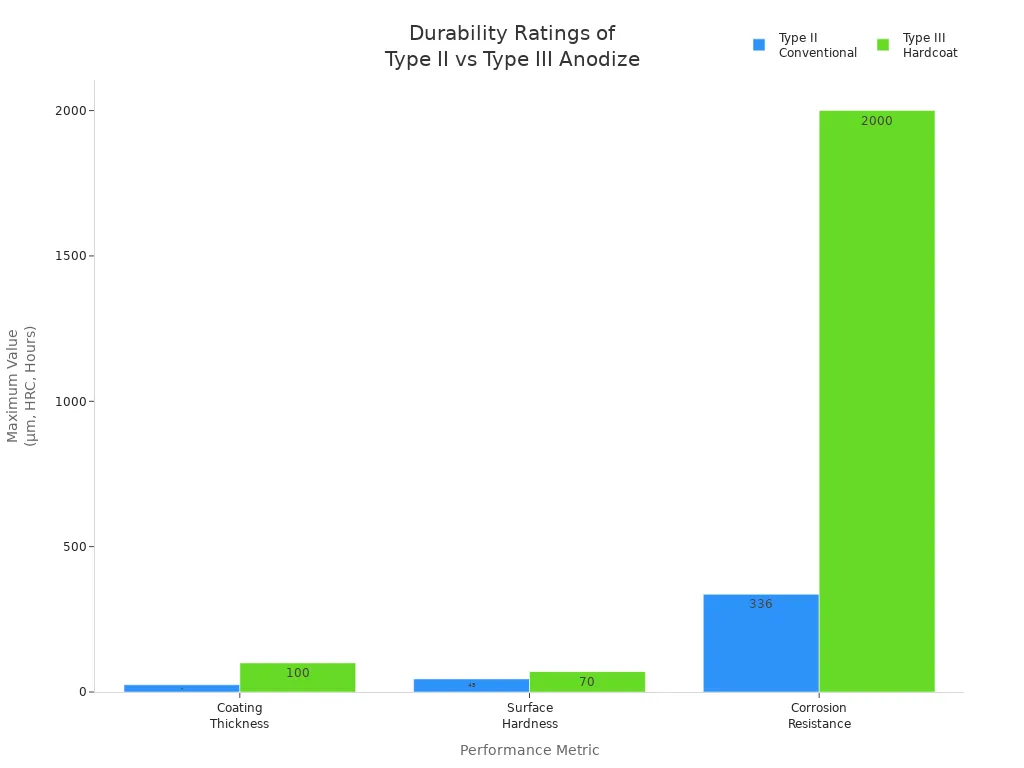
The following table summarizes the durability ratings according to ASTM standards:
Performance Metric | Type II (Conventional Anodize) | Type III (Hardcoat Anodize) |
|---|---|---|
Coating Thickness | 0.0002″ – 0.001″ (5 – 25 µm) | 0.001″ – 0.004″ (25 – 100 µm) |
Surface Hardness | 30 – 45 HRC (200 – 400 HV) | 60 – 70 HRC (600 – 700 HV) |
Abrasion Resistance | Moderate | Excellent |
Corrosion Resistance | 336+ Hours | 1000 – 2000+ Hours |
Type iii anodizing is the preferred choice for parts exposed to high-wear environments, such as industrial machinery, aerospace components, and marine hardware. Type ii anodizing remains a cost-effective solution for decorative or lightly used parts.
The average lifespan of these coatings also reflects their durability:
Coating Type | Average Lifespan | Notes |
|---|---|---|
Type II Anodized | 10-15 years | Shorter lifespan, especially in high-wear settings |
Type III Anodized | 15-20+ years | Longer lifespan, more durable in tough conditions |
Type ii anodizing typically lasts 10-15 years in outdoor environments.
Type iii anodizing can last 15-20 years or more, depending on maintenance and exposure.
The thickness and hardness of the anodized layer play a direct role in the performance of aluminum parts. Type ii anodizing produces a thinner protective layer, usually between 5 and 25 micrometers. This is sufficient for many consumer products and applications where tight tolerances are important. The surface hardness achieved with type ii anodizing ranges from 200 to 400 HV (Vickers), which is significantly higher than untreated aluminum.
Type iii anodizing, by contrast, forms a much thicker layer—typically 25 to 100 micrometers. This hardcoat process results in surface hardness values between 600 and 700 HV, rivaling or exceeding the hardness of stainless steel. The increased thickness and hardness provide superior wear resistance and protection against mechanical damage.
The following chart visually compares coating thickness, surface hardness, and corrosion resistance for both anodizing types:
A comparison of hardness values for common materials:
Material | Hardness (Vickers) |
|---|---|
Untreated Aluminum Alloy 6082 | HV 100 – 120 |
Hard-Anodized Alloy | HV 400 – 460 |
Stainless Steel | HV 300 – 350 |
Mild Steel | HV 200 – 220 |
The hardcoat layer from type iii anodizing delivers a level of wear resistance and surface protection that is unmatched by standard anodizing processes.
Appearance and color flexibility are important considerations for many industries. Type ii anodizing offers a wide range of color options, including clear, black, blue, red, green, gold, and custom shades. The porous nature of the protective layer allows dyes to penetrate deeply, resulting in vibrant and long-lasting finishes. This makes type ii anodizing ideal for consumer products, electronics, and architectural elements where aesthetics matter.
Type iii anodizing, while superior in wear resistance, has more limited color choices. The dense and thick protective layer restricts dye absorption, so most parts finished with type iii anodizing appear in shades of gray, dark bronze, or black. These finishes are highly functional and provide excellent corrosion resistance, but they do not offer the same level of visual customization as type ii anodizing.
Type ii anodizing is best for projects that require both decorative appeal and moderate protection.
Type iii anodizing is chosen when maximum durability and wear resistance are the top priorities, even if color options are limited.
Welden’s expertise ensures that each anodizing process delivers the right balance of appearance, performance, and protection for your application.
Cost plays a significant role in selecting the right anodizing process for aluminum parts. Type II anodizing is generally more affordable than Type III. The process for Type II requires less energy, operates at higher temperatures, and uses lower current densities. These factors reduce operational costs and make Type II a cost-effective choice for many applications.
Type III anodizing, also known as hardcoat anodizing, involves a more intensive process. It requires lower bath temperatures and higher current densities. These conditions increase energy consumption and extend processing times. The thicker, denser oxide layer produced by Type III also demands more precise control and specialized equipment. As a result, the cost per part is higher.
The following table summarizes the typical cost differences:
Anodizing Type | Average Cost per Part | Main Cost Drivers |
|---|---|---|
Type II | $8 | Lower energy, faster processing |
Type III | $15 | Higher energy, longer processing |
Tip: When budgeting for a project, consider not only the initial cost but also the potential savings from reduced maintenance and longer part lifespan, especially in environments with high corrosion risk.
For high-volume production runs where appearance and moderate protection are priorities, Type II anodizing offers excellent value. For critical components exposed to severe wear or aggressive environments, the higher upfront cost of Type III can be justified by its superior durability and corrosion resistance.
Choosing between Type II and Type III anodizing depends on the specific requirements of your application. Each process offers unique advantages that align with different performance needs.
Type II Anodizing is best suited for:
Consumer products where appearance and color variety are important.
Parts that require moderate corrosion protection in indoor or mild outdoor environments.
Components with tight dimensional tolerances.
Applications where cost control is a primary concern.
Type III Anodizing is ideal for:
Industrial machinery and equipment exposed to heavy wear.
Aerospace and marine components that face harsh environments and require maximum corrosion resistance.
Parts that must withstand frequent cleaning, abrasion, or chemical exposure.
Applications where extended service life and minimal maintenance are critical.
The following checklist can help guide your decision:
Assess the operating environment: Will the part face high wear, abrasion, or aggressive chemicals?
Determine the importance of appearance: Is a wide range of colors or a decorative finish required?
Evaluate budget constraints: Is initial cost or long-term durability more important?
Consider dimensional requirements: Does the part need to maintain tight tolerances after anodizing?
Note: Welden’s team can provide expert guidance to match the right anodizing process to your project’s needs, ensuring optimal performance and protection against corrosion.
By carefully evaluating these factors, engineers and buyers can select the most suitable anodizing type for their aluminum parts, balancing cost, performance, and longevity.
Selecting the right surface treatment for your aluminum components is a critical step in ensuring optimal performance and longevity. The question of how to know if type ii anodizing is right for my aluminum parts? requires a careful evaluation of several factors. This section will help you navigate the decision-making process by examining key considerations, comparing scenarios where type ii is preferable to type iii, and outlining the main limitations of type ii anodizing.
When determining how to know if type ii anodizing is right for my aluminum parts?, it is important to assess the specific environment, expected wear, desired aesthetics, and budget constraints. Each of these factors plays a significant role in the final decision.
Operating Environment: Type ii anodizing performs well in indoor or mild outdoor settings. It offers moderate protection against corrosion, making it suitable for parts that do not face aggressive chemicals or constant abrasion.
Wear and Usage: If your parts will experience light to moderate handling, type ii anodizing provides sufficient durability. It is not intended for high-wear or heavy-duty applications.
Aesthetic Requirements: Type ii anodizing supports a wide range of vibrant colors and finishes. This makes it ideal for consumer products, electronics, and architectural elements where appearance is a priority.
Cost Considerations: Projects with strict budget requirements often benefit from the cost-effectiveness of type ii anodizing. The process is less energy-intensive and faster than hardcoat options.
Environmental responsibility is another important aspect. The table below summarizes key environmental factors to consider when evaluating how to know if type ii anodizing is right for my aluminum parts?:
Environmental Factor | Description |
|---|---|
Management of hazardous chemicals | Proper management of chemicals like sulfuric and chromic acid is crucial to prevent hazardous waste. |
Energy consumption | Anodizing requires significant electricity; using renewable energy can reduce the carbon footprint. |
Sustainability of the anodizing process | The anodized layer is non-toxic and enhances durability, contributing to reduced material waste. |
Welden’s team offers expert consultation to help you assess these factors and select the most appropriate anodizing solution for your application.
Understanding how to know if type ii anodizing is right for my aluminum parts? involves comparing the advantages of type ii with those of type iii. Type ii is the preferred choice in the following scenarios:
Aesthetic Flexibility: When your parts require a specific color or decorative finish, type ii anodizing delivers superior results. The process allows for deep dye penetration and a broad palette of colors.
Tight Tolerances: For components that must maintain precise dimensions, the thinner oxide layer of type ii minimizes dimensional changes.
Moderate Service Conditions: If your parts will not be exposed to extreme abrasion, heavy mechanical stress, or harsh chemicals, type ii provides adequate protection.
Cost Efficiency: Projects with large production volumes or limited budgets benefit from the lower processing costs of type ii anodizing.
When evaluating how to know if type ii anodizing is right for my aluminum parts?, consider the following checklist:
The part will be used in a controlled or indoor environment.
Appearance and color customization are important.
The application does not involve high-wear or aggressive exposure.
Budget constraints favor a more economical process.
Welden’s specialists can guide you through these considerations, ensuring your parts receive the optimal finish for their intended use.
While type ii anodizing offers many advantages, it is essential to recognize its limitations when deciding how to know if type ii anodizing is right for my aluminum parts?. The process may not be suitable for every application, especially where maximum durability is required.
Type ii anodizing is not suitable for high-wear applications.
MIL-PRF-8625F does not specify wear index requirements for type ii, indicating a lack of measurable wear resistance.
The porous nature of type ii coating makes it susceptible to abrasion damage and environmental degradation.
Type ii provides adequate durability for indoor applications but underperforms compared to type iii and powder coating in terms of wear resistance.
Type ii may not be ideal for applications requiring high corrosion or abrasion resistance due to its porous nature.
For parts that must withstand frequent abrasion, harsh chemicals, or outdoor exposure, type iii anodizing or alternative coatings may offer better long-term protection.
Welden’s consultation services can help you navigate these limitations and select the best anodizing process for your project. Their expertise ensures that each part receives the right balance of protection, appearance, and cost-effectiveness.
Selecting the optimal anodizing process for your aluminum parts requires a clear understanding of both the application environment and the mechanical demands placed on each component. The right choice ensures long-term performance, cost efficiency, and compliance with industry standards.
The operating environment and mechanical requirements play a decisive role in the selection process. Consider the following factors:
Type II anodizing works well for projects that prioritize color variety and visual appeal. It is suitable for parts exposed to moderate wear and non-aggressive environments.
Type III anodizing, also known as hard anodizing, creates a thicker and more robust oxide layer. This makes it ideal for applications demanding strong protection, especially in harsh settings such as aerospace, military, and heavy machinery.
Industrial and military applications often require the enhanced durability provided by Type III anodizing, as these parts must withstand frequent abrasion and mechanical stress.
Tip: Always assess the expected exposure to chemicals, temperature extremes, and mechanical loads before finalizing your anodizing process.
Budget constraints and desired aesthetics can significantly influence the choice between Type II and Type III anodizing. Key considerations include:
Type II anodizing is generally more affordable, making it a preferred option for large production runs or when cost control is essential.
Custom colors may increase costs, especially for smaller batches. Standard colors offer a more economical solution.
Order quantity impacts pricing. Larger volumes typically reduce the cost per piece, making high-volume projects more cost-effective.
When appearance and branding are important, Type II anodizing provides a broader palette of color options. For projects where durability outweighs aesthetics, Type III remains the better choice.
Meeting industry standards is critical, especially for sectors such as aerospace and medical devices. The following table outlines key requirements:
Standard Type | Description |
|---|---|
Type II Anodizing | Increases corrosion and scratch resistance, allows for dyeing |
Type III Anodizing | Provides a dense and durable coating for maximum scratch and wear resistance |
Sterilization Resistance | Must withstand 50 to 100 cycles of sterilization without loss of integrity |
Enhanced corrosion resistance and increased strength are essential for compliance.
Effective sterilization is required for medical and food-grade applications.
For complex or high-spec projects, consulting with Welden’s experts ensures that your anodizing process meets all technical and regulatory requirements. Welden’s team can help you navigate the balance between performance, cost, and compliance, delivering solutions tailored to your industry.
Type II anodizing finds widespread use in consumer products where both appearance and moderate durability matter. Manufacturers often select this process for items that require a clean, attractive finish and a range of color options. Many electronics, such as smartphone cases, laptop housings, and audio equipment, feature Type II anodized surfaces. This finish not only enhances the visual appeal but also provides a layer of protection against scratches and fingerprints.
Household goods, including kitchen utensils, cookware, and lighting fixtures, benefit from Type II anodizing. The process allows for vibrant colors and a smooth surface, making these parts more appealing to consumers. Sporting goods, such as bicycle components and golf clubs, also use this method to achieve a balance between aesthetics and resistance to everyday wear. Companies value the repeatability and cost-effectiveness of Type II anodizing for high-volume production of machined aluminum parts.
Type III anodizing, also known as hardcoat anodizing, serves industries that demand maximum durability and protection. This process creates a thick, dense oxide layer that withstands harsh environments and heavy use. Many sectors rely on Type III anodizing for critical components.
Aerospace: Aircraft landing gear and hydraulic systems require enhanced durability and corrosion resistance.
Automotive: Engine parts and transmission systems benefit from improved performance and longevity.
Military: Weapons, ammunition, and tactical gear must endure extreme conditions and frequent handling.
Marine: Boat parts and equipment need protection from saltwater corrosion.
Industrial: Heavy machinery and tools operate in rigorous environments and depend on robust finishes.
These applications demonstrate the importance of selecting the right anodizing process for parts that face demanding operational conditions.
Welden has extensive experience delivering anodized solutions for a variety of industries. The company recently partnered with a manufacturer of precision medical devices. The client required machined aluminum parts with a durable, easy-to-clean surface that could withstand repeated sterilization cycles. Welden recommended Type III anodizing for these components. The result was a finish that met strict hygiene standards and provided long-term resistance to wear and corrosion.
In another project, Welden supplied anodized housings for consumer electronics. The client prioritized appearance and branding, so Welden used Type II anodizing to achieve a vibrant, uniform color across all parts. The process ensured consistent quality and a premium look, helping the client stand out in a competitive market.
Welden’s ability to tailor anodizing solutions to specific requirements ensures that each part performs reliably, whether in a hospital, a factory, or a consumer’s home.
Selecting the right anodizing process for aluminum parts requires careful planning and attention to detail. Many organizations encounter setbacks due to common mistakes during specification, design, or production. Understanding these pitfalls can help ensure optimal performance and cost efficiency.
1. Overlooking Application Requirements
Many engineers select an anodizing type based on cost or appearance alone. This approach can lead to premature wear or corrosion. Always match the anodizing type to the part’s operating environment and mechanical demands. For example, using Type II anodizing for parts exposed to heavy abrasion or chemicals often results in rapid surface degradation.
2. Ignoring Tolerance Changes
Anodizing adds thickness to aluminum surfaces. Failing to account for this dimensional change can cause assembly issues or part rejection. Specify critical tolerances with the anodized layer in mind. Consult with your anodizing provider early in the design phase to avoid costly rework.
3. Inadequate Surface Preparation
Surface contaminants such as oil, grease, or oxide residues can compromise the quality of the anodized finish. Poor preparation leads to uneven coatings, reduced corrosion resistance, and inconsistent color. Ensure all parts undergo thorough cleaning and inspection before anodizing.
4. Misunderstanding Color Limitations
Type III anodizing offers limited color options due to its dense oxide layer. Attempting to achieve vibrant or custom colors with Type III often results in muted or inconsistent finishes. For projects where color is critical, choose Type II anodizing and communicate color requirements clearly.
5. Neglecting Post-Anodizing Sealing
Unsealed anodized layers remain porous and vulnerable to staining or chemical attack. Always specify sealing for both Type II and Type III anodizing unless the application requires an unsealed surface for bonding or conductivity.
Tip: Early collaboration with your anodizing partner can prevent most specification errors. Welden’s team provides guidance on process selection, tolerances, and finishing options to ensure your parts meet all functional and aesthetic requirements.
Summary Table: Key Mistakes and Solutions
Mistake | Impact | Solution |
|---|---|---|
Wrong anodizing type | Premature failure | Match process to application |
Ignoring thickness/tolerance | Assembly problems | Specify tolerances post-anodizing |
Poor surface preparation | Defective finish | Ensure thorough cleaning |
Unrealistic color expectations | Unsatisfactory appearance | Choose correct anodizing type |
Skipping sealing | Reduced durability | Always specify sealing |
Avoiding these mistakes will help you achieve reliable, high-quality anodized parts. Welden’s expertise ensures that every project benefits from best practices and industry-leading support.
Selecting the right anodizing process for your project can feel complex, but a structured approach simplifies the decision. Use the following checklist to evaluate your requirements and match them to the most suitable process for your aluminum parts.
Decision Point | What to Consider |
|---|---|
Primary Failure Mode | Is the main risk corrosion, abrasion, fatigue, or chemical exposure? |
Service Environment | Will the part operate indoors, outdoors, or in a sterile setting? |
Dimensional Tolerance | Does your design require tight tolerances? Type III adds more thickness and may need adjustments. |
Electrical Conductivity | Does the application require grounding or electrical contact? Special processing may be needed. |
Identify the main threat to your part’s performance. Corrosion and abrasion call for different levels of protection.
Assess the environment. Outdoor or harsh settings often require the enhanced durability of Type III.
Review your dimensional needs. Type II is better for tight tolerances, while Type III may require design changes.
Consider electrical requirements. Some applications need conductive surfaces, which can affect the anodizing choice.
Tip: A clear understanding of these factors leads to a more reliable and cost-effective outcome.
Certain projects demand more than a checklist. Consulting an anodizing specialist ensures that your aluminum parts receive the optimal finish for their intended use. Welden’s team provides guidance at every stage, from design to final inspection.
Factor | Why It Matters |
|---|---|
Desired Properties | Need for maximum corrosion resistance, increased hardness, or other specific attributes. |
Intended Use & Industry Standards | Applications with strict regulatory or industry requirements, such as aerospace or medical. |
Design & Geometry | Complex shapes or large parts may require tailored processing for uniform coatings. |
Environmental & Regulatory Concerns | Sustainability goals or restrictions on certain chemicals may influence process selection. |
Budget | High-performance coatings can increase costs; expert advice helps balance performance and price. |
Reach out to an expert if your project involves unique environments, complex geometries, or strict compliance needs.
Early consultation helps prevent costly mistakes and ensures your parts meet all technical and regulatory standards.
Welden’s specialists are ready to help you navigate the anodizing process. Their expertise supports you in achieving the right balance of durability, appearance, and cost for your application.
By following this guide and seeking expert input when needed, you can confidently select the best anodizing solution for your aluminum parts.
Choosing between Type II and Type III anodizing depends on several critical factors. The table below highlights the main considerations:
Factor | Type II Anodizing | Type III Anodizing |
|---|---|---|
Application | Light-duty, less harsh settings | Extreme conditions, high wear |
Aesthetics | Vibrant colors, decorative | Limited colors, natural finish |
Budget | Cost-effective | Higher cost, robust protection |
Production Timeline | Faster processing | Longer processing |
Selecting the right anodizing process ensures your parts meet performance and appearance goals. For complex projects, consult a specialist like Welden and use the checklist provided to guide your decision.
Type II anodizing creates a thinner, decorative oxide layer. Type III, also called hardcoat anodizing, produces a much thicker and harder surface. Type III offers superior wear and corrosion resistance, making it suitable for demanding industrial applications.
Yes, Type II anodized parts can be used outdoors. However, they perform best in mild environments. For harsh or highly corrosive conditions, Type III anodizing provides better long-term protection.
Type II anodizing supports a wide range of vibrant colors due to its porous oxide layer. Type III anodizing has limited color choices, usually gray, black, or dark bronze, because the dense layer absorbs less dye.
Anodizing adds thickness to the aluminum surface. Type II increases thickness by 5–25 µm, while Type III adds 25–100 µm. Always account for this change during the design phase to maintain proper tolerances.
Anodizing is considered environmentally friendly. The process produces a non-toxic, durable finish and generates minimal waste. Welden follows strict environmental controls to ensure responsible chemical management and energy use.
Yes, Welden provides custom anodizing services. The team tailors thickness, color, and finish to meet specific project requirements. Welden also offers expert consultation to help select the best process for your application.
Use this quick guide:
Requirement | Recommended Type |
|---|---|
Decorative finish | Type II |
High wear resistance | Type III |
Tight tolerances | Type II |
Harsh environments | Type III |
Consult Welden for complex or high-spec projects.